


Value contains a number of financial terms used in calculations, so for those planning to build financial focused tools to express future or realized value, here some of the most important:
Return on Investment (ROI)
An approximate measure of an investment's profitability. ROI is calculated by subtracting the initial value of the investment from the final value of the investment (which equals the net return), then dividing this new number (the net return) by the cost of the investment, then finally, multiplying it by 100.

Net Present Value (NPV)
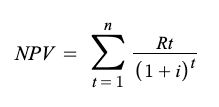
NPV is used to understand if the cash flow generated covers an organizations cost of capital, which is defined by the weighted average of debt & equity %. A company may choose to measure or calculate NPV based on an individual investment return % or specific interest rate they pay. Relating to investment equity return, if the NPV of a project or investment is positive, it means that the discounted present value of all future cash flows related to that project or investment will be positive.
Example: An organization takes out a $396,000 annual line of credit to pay for Mediafly at 5.8% interest. They have no money to invest. In this case the organization would have a cost of capital of 5.8%. As such the cashflows generated by Mediafly over the selected time period needs to generate an NPV greater than zero$ to cover the cost of capital.
-
- Rt - Net cash flow during a single period
- i - Discount rate or return that could be earned in alternative investments
- t - number of time periods
Internal Rate of Return (IRR)
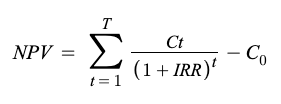
Annual rate of growth that an investment is expected to generate. IRR is calculated such that the net present value of an investment yields zero, and therefore allows the comparison of the performance of unique investments over varying periods of time. This is done by dividing the future value by the present value, raised to the power of the number of periods.
-
- Ct - net cash inflow during period t
- C0 - total initial investment cost
- IRR - Internal Rate of Return
- t - number of time periods
- NPV - Net Present Value
Payback Period
Length of time it takes to recoup the initial investment. However, this assumes that the benefits are realized across each year and that the investment is front loaded prior to realization. Make sure to pay attention to the deployment periods and benefit realization types (annualized vs allocated) when considering the payback period in your analysis.

Annual benefit potential (Probable)
Cumulative net effect of all benefits after impact


Cost of "Do Nothing" per month (Probable)
Cost of not taking any action and how much it will cost the prospect/customer each month their strategy stays the same

Expected X years realized benefits
Expected net total value over the analysis period


Average annual realized benefits
Average annual realized benefits is calculated by dividing the Expected average realized benefit value by the analysis period

Total Realized Impact
This is the total impact in dollars that has been achieved over a specific time period. This is calculated by taking the sum of all included benefits multiplied by their respective realization factors across the analysis period.
Total realized Impact = ((Benefit A amount x Benefit A realization factors) + (Benefit B amount x Benefit B realization factor) +...) x analysis period.
Discount Rate
The discount rate is used to calculate the present value of future cash flows from an investment, which can be used to determine the net present value (NPV) of an investment's gains and costs. The NPV can then be used to calculate a discounted return on investment (ROI).
A discount rate represents the time value of money, and it incorporates factors like expected inflation, opportunity costs, and risk. It's also known as the opportunity cost of capital. A higher discount rate means that future cash flows are worth less today, and a lower discount rate means that they're worth more.
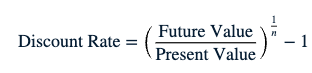
The discount rate is calculated by dividing the future value of a cash flow (FV) by the present value (PV). For example, if the future value is $5,000, the present value is $3,500, and the number of years is 10, the discount rate would be calculated as follows:
(Discount Rate=((5,000/3,500)^{1}/10)-1)
Replies have been locked on this page!